Teoria e pratica della formazione
Contents
- 1 <a href="http://eacea.ec.europa.eu/youth/tools/partner_search_en.php">Search and find Youth partners</a>
- 2 <a href="http://people.uis.edu/rschr1/onlinelearning/2009/04/institute-for-emerging-leadership-in.html">Institute for Emerging Leadership in Online Learning</a>
- 3 <a href="http://www.managesmarter.com/msg/content_display/training/e3i2fea4bd91d0d44f9411198cab5535630">Measurements for Evaluation and Management of the Training Department (PART 2 OF 4)</a>
- 4 <a href="http://people.uis.edu/rschr1/onlinelearning/2009/04/engaging-students-in-virtual-learning.html">Engaging Students in Virtual Learning - Denise Harrison, Campus Technology</a>
- 5 <a href="http://springwise.com/telecom_mobile/txteagle/">Quick tasks via SMS for phone users in the developing world</a>
- 6 <a href="http://people.uis.edu/rschr1/onlinelearning/2009/04/importance-of-teacher-professional.html">The Importance of Teacher Professional Development - Mary Ann Wolf, Huffington Post</a>
- 7 <a href="http://www.etf.europa.eu/Web.nsf/(RSS)/E65C8123E1782966C12575A7003907BF?OpenDocument&LAN=EN">ETF celebrates 15 years on Europe Day</a>
- 8 <a href="http://people.uis.edu/rschr1/onlinelearning/2009/04/please-sir-can-i-have-some-more.html">Please Sir, can I have some more… elearning, blended learning, wikis, forums, blogs? - Francis Marshall, Training Zone</a>
- 9 <a href="http://people.uis.edu/rschr1/onlinelearning/2009/04/five-questionsfor-george-siemens-lisa.html">FIVE QUESTIONS...For George Siemens - Lisa Neal Gualtieri, eLearn Magazine</a>
- 10 <a href="http://feedproxy.google.com/~r/ScienceblogsChannelEducation/~3/pNXoRsoF7q8/overpaying_for_educational_und.php">Overpaying for Educational Underachievement [Neuron Culture]</a>
<a href="http://eacea.ec.europa.eu/youth/tools/partner_search_en.php">Search and find Youth partners</a>
<a href="http://people.uis.edu/rschr1/onlinelearning/2009/04/institute-for-emerging-leadership-in.html">Institute for Emerging Leadership in Online Learning</a>
<a href="http://www.managesmarter.com/msg/content_display/training/e3i2fea4bd91d0d44f9411198cab5535630">Measurements for Evaluation and Management of the Training Department (PART
2 OF 4)</a>
<a href="http://people.uis.edu/rschr1/onlinelearning/2009/04/engaging-students-in-virtual-learning.html">Engaging Students in Virtual Learning - Denise Harrison, Campus Technology</a>
<a href="http://springwise.com/telecom_mobile/txteagle/">Quick tasks via SMS for phone users in the developing world</a>
<a href="http://www.springwise.com/telecom_mobile/txteagle/"><img src="http://www.springwise.com/pix/spotlight/txteagle.jpg"></a>
Both <a href="http://springwise.com/life_hacks/shorttask/">ShortTask</a> and <a href="https://www.mturk.com/mturk/welcome">Amazon's Mechanical Turk</a> enable Internet-connected computer users to earn money performing quick tasks for organizations far and wide. Now, a new project aims to bring similar income opportunities to those in the developing world using the ubiquitous mobile phone.
Targeting the more than 2 billion literate mobile phone subscribers in the developing world, <a href="http://www.txteagle.com">txteagle</a> aims to help alleviate high unemployment levels in many rural areas of countries like Kenya with a crowdsourcing approach that offers new ways to earn extra money. The service connects corporations with small tasks to be completed—currently, the most common ones include software localization and translation into local dialects for companies like Nokia—and native people who can complete them in minutes by cell phone. Tasks are sent to multiple phone users by text message—"translate the phrase, 'address book' into Giriama," for example—and answers are accepted as accurate when the majority of users provide the same response. Compensation is determined by the number of times an individual’s response agrees with the consensus; penalties are imposed for wrong answers, while "don’t know" responses make no contribution. Over time the system learns a particular user's expertise, and can actively select the most appropriate tasks for them. It can also weight answers from long-term and historically accurate users higher than others, making it necessary to involve fewer other individuals when those users respond. Payment is made either to a bank account connected with an individual's phone number—accessible at any post office or local kiosk—or via airtime credit transfers.
The txteagle service is currently deployed in Kenya via Mobile Planet and Safaricom, and will soon be launching in Rwanda through MTN Rwanda and in the Dominican Republic through Viva. Additional partnerships in Africa and South America will be announced later this year, txteagle says. Also in the works is a version of the service that uses the commonly found Unstructured Supplementary Service Data (USSD) protocol instead of SMS. One to partner with, try out or otherwise get involved in...?
Website: <a href="http://www.txteagle.com">www.txteagle.com</a>
Contact: <a href="mailto:info@txteagle.com">info@txteagle.com</a>
Spotted by: Susanna Haynie
<a href="http://people.uis.edu/rschr1/onlinelearning/2009/04/importance-of-teacher-professional.html">The Importance of Teacher Professional Development - Mary Ann Wolf, Huffington Post</a>
<a href="http://www.etf.europa.eu/Web.nsf/(RSS)/E65C8123E1782966C12575A7003907BF?OpenDocument&LAN=EN">ETF celebrates 15 years on Europe Day</a>
<a href="http://people.uis.edu/rschr1/onlinelearning/2009/04/please-sir-can-i-have-some-more.html">Please Sir, can I have some more… elearning, blended learning, wikis, forums, blogs? - Francis Marshall, Training Zone</a>
<a href="http://people.uis.edu/rschr1/onlinelearning/2009/04/five-questionsfor-george-siemens-lisa.html">FIVE QUESTIONS...For George Siemens - Lisa Neal Gualtieri, eLearn Magazine</a>
<a href="http://feedproxy.google.com/~r/ScienceblogsChannelEducation/~3/pNXoRsoF7q8/overpaying_for_educational_und.php">Overpaying for Educational Underachievement [Neuron Culture]</a>
As I've noted before, the U.S.'s health-care and education systems share some fundamental flaws: In both medical care and schooling we spend far more than other countries and get substandard results; in both cases, the overspending and poor results occur partly because our decentralized "systems" mean everyone does and measures everything differently, so you can't compare apples to oranges to even find out what works.
The folks at Economix <a href="http://economix.blogs.nytimes.com/2009/04/22/overpaying-for-educational-underachievement">look at this dynamic</a> in education from a return-on-investment perspective:
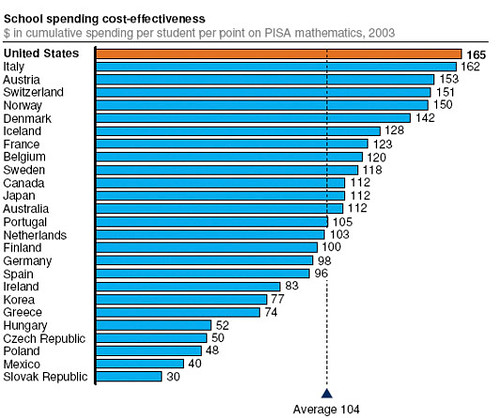
Education is a form of investment in a country%u2019s labor force and its overall economy. This means that educational shortcomings drag on economic growth. McKinsey estimates that:<a href="http://www.flickr.com/photos/60472435@N00/3486681130" title="View 'edugraf' on Flickr.com"><img src="http://farm4.static.flickr.com/3325/3486681130_40d20f845d.jpg" alt="edugraf" border="0" width="500" height="418"></a> <a href="http://scienceblogs.com/neuronculture/2009/04/overpaying_for_educational_und.php#commentsArea">Read the comments on this post...</a><img src="http://feeds2.feedburner.com/~r/ScienceblogsChannelEducation/~4/pNXoRsoF7q8" height="1" width="1">If the United States had in recent years closed the gap between its educational achievement levels and those of better-performing nations such as Finland and Korea, G.D.P. in 2008 could have been $1.3 trillion to $2.3 trillion higher. This represents 9 to 16 percent of G.D.P.
Similarly, if the United States had been able to narrow the achievement gap between white students and their black and Latino peers, the country%u2019s G.D.P. would have been an estimated $310 billion to $525 billion higher, or 2 to 4 percent of G.D.P.
Unfortunately, throwing money at the system doesn%u2019t seem to help, either. As it is, the United States gets comparatively little bang for its buck on education spending. The United States spends more than any other country per point on the PISA math exam, and 60 percent more than the O.E.C.D. average: