Difference between revisions of "Teoria e pratica della formazione"
(Pagina svuotata completamente) |
m (added by Robot) |
||
| Line 1: | Line 1: | ||
| + | <htm><div class="news-item"><div style="font-family:sans-serif;overflow:auto;width:100%;margin: 0px 10px"><h2 style="margin: 0.25em 0 0 0"><div class=""><a href="http://eacea.ec.europa.eu/youth/tools/partner_search_en.php">Search and find Youth partners</a></div></h2> | ||
| + | <div style="margin-bottom: 0.5em">via <a href="http://eacea.ec.europa.eu/rss/youth_en.xml" class="f">Youth</a> on 4/27/09</div><br style="display:none"> | ||
| + | A list of existing partner search for the Youth in Action programme is now available</div> | ||
| + | <br></div></htm> | ||
| + | <htm><div class="news-item"><div style="font-family:sans-serif;overflow:auto;width:100%;margin: 0px 10px"><h2 style="margin: 0.25em 0 0 0"><div class=""><a href="http://people.uis.edu/rschr1/onlinelearning/2009/04/institute-for-emerging-leadership-in.html">Institute for Emerging Leadership in Online Learning</a></div></h2> | ||
| + | <div style="margin-bottom: 0.5em">via <a href="http://people.uis.edu/rschr1/onlinelearning/blogger.html" class="f">Online Learning Update</a> by Ray on 4/27/09</div><br style="display:none"> | ||
| + | The Institute for Emerging Leadership in Online Learning is a unique blended-learning leadership development program sponsored by Penn State and the Sloan Consortium. This institute is designed to serve the leadership development needs of professionals in the rapidly expanding field of online learning. The program begins with an immersive experience at Penn State beginning August 10, followed by an eight-week online program enabling the participants to apply the new skills and concepts in their local settings. The program culminates with a preconference workshop at the annual Sloan Consortium ALN conference in Orlando.<div><img width="1" height="1" src="http://res1.blogblog.com/tracker/3058503-6158429605570517319?l=people.uis.edu%2Frschr1%2Fonlinelearning%2Fblogger.html"></div></div> | ||
| + | <br></div></htm> | ||
| + | |||
| + | <htm><div class="news-item"><div style="font-family:sans-serif;overflow:auto;width:100%;margin: 0px 10px"><h2 style="margin: 0.25em 0 0 0"><div class=""><a href="http://www.managesmarter.com/msg/content_display/training/e3i2fea4bd91d0d44f9411198cab5535630">Measurements for Evaluation and Management of the Training Department (PART | ||
| + | 2 OF 4)</a></div></h2> | ||
| + | <div style="margin-bottom: 0.5em">via <a href="http://www.managesmarter.com" class="f">ManageSmarter.com - Training Top Stories</a> by Dan Klein, Ph.D. on 4/27/09</div><br style="display:none"> | ||
| + | You've heard of Kirkpatrick? He's not the last word on evaluation, according to one researcher. There's another way to approach evaluation that most of you have never considered.</div> | ||
| + | <br></div></htm> | ||
| + | |||
| + | <htm><div class="news-item"><div style="font-family:sans-serif;overflow:auto;width:100%;margin: 0px 10px"><h2 style="margin: 0.25em 0 0 0"><div class=""><a href="http://people.uis.edu/rschr1/onlinelearning/2009/04/engaging-students-in-virtual-learning.html">Engaging Students in Virtual Learning - Denise Harrison, Campus Technology</a></div></h2> | ||
| + | <div style="margin-bottom: 0.5em">via <a href="http://people.uis.edu/rschr1/onlinelearning/blogger.html" class="f">Online Learning Update</a> by Ray on 4/27/09</div><br style="display:none"> | ||
| + | A visit to the virtual campus of Greenville, NC-based East Carolina University makes it clear that this is a working campus--walls displaying dozens of renderings and peer review instructions, graphics explaining management principles, and a career services center that leads job seekers to Web pages about improving resumes, long-distance job searching, and stress-free interviewing. "This semester, we are teaching 10 courses in Second Life," said Sharon Collins, project manager for Academic Outreach Technology Services. Collins manages ECU's Second Life activities.<div><img width="1" height="1" src="http://res1.blogblog.com/tracker/3058503-7624399780204076216?l=people.uis.edu%2Frschr1%2Fonlinelearning%2Fblogger.html"></div></div> | ||
| + | <br></div></htm> | ||
| + | |||
| + | <htm><div class="news-item"><div style="font-family:sans-serif;overflow:auto;width:100%;margin: 0px 10px"><h2 style="margin: 0.25em 0 0 0"><div class=""><a href="http://springwise.com/telecom_mobile/txteagle/">Quick tasks via SMS for phone users in the developing world</a></div></h2> | ||
| + | <div style="margin-bottom: 0.5em">via <a href="http://springwise.com/" class="f">Springwise</a> by Springwise on 4/28/09</div><br style="display:none"> | ||
| + | <p><a href="http://www.springwise.com/telecom_mobile/txteagle/"><img src="http://www.springwise.com/pix/spotlight/txteagle.jpg"></a></p> | ||
| + | |||
| + | <p>Both <a href="http://springwise.com/life_hacks/shorttask/">ShortTask</a> and <a href="https://www.mturk.com/mturk/welcome">Amazon's Mechanical Turk</a> enable Internet-connected computer users to earn money performing quick tasks for organizations far and wide. Now, a new project aims to bring similar income opportunities to those in the developing world using the ubiquitous mobile phone. </p> | ||
| + | |||
| + | <p>Targeting the more than 2 billion literate mobile phone subscribers in the developing world, <a href="http://www.txteagle.com">txteagle</a> aims to help alleviate high unemployment levels in many rural areas of countries like Kenya with a crowdsourcing approach that offers new ways to earn extra money. The service connects corporations with small tasks to be completed—currently, the most common ones include software localization and translation into local dialects for companies like Nokia—and native people who can complete them in minutes by cell phone. Tasks are sent to multiple phone users by text message—"translate the phrase, 'address book' into Giriama," for example—and answers are accepted as accurate when the majority of users provide the same response. Compensation is determined by the number of times an individual’s response agrees with the consensus; penalties are imposed for wrong answers, while "don’t know" responses make no contribution. Over time the system learns a particular user's expertise, and can actively select the most appropriate tasks for them. It can also weight answers from long-term and historically accurate users higher than others, making it necessary to involve fewer other individuals when those users respond. Payment is made either to a bank account connected with an individual's phone number—accessible at any post office or local kiosk—or via airtime credit transfers.</p> | ||
| + | |||
| + | <p>The txteagle service is currently deployed in Kenya via Mobile Planet and Safaricom, and will soon be launching in Rwanda through MTN Rwanda and in the Dominican Republic through Viva. Additional partnerships in Africa and South America will be announced later this year, txteagle says. Also in the works is a version of the service that uses the commonly found Unstructured Supplementary Service Data (USSD) protocol instead of SMS. One to partner with, try out or otherwise get involved in...?</p> | ||
| + | |||
| + | <p>Website: <a href="http://www.txteagle.com">www.txteagle.com</a><br> | ||
| + | Contact: <a href="mailto:info@txteagle.com">info@txteagle.com</a></p> | ||
| + | |||
| + | <p>Spotted by: Susanna Haynie</p></div> | ||
| + | <br></div></htm> | ||
| + | |||
| + | <htm><div class="news-item"><div style="font-family:sans-serif;overflow:auto;width:100%;margin: 0px 10px"><h2 style="margin: 0.25em 0 0 0"><div class=""><a href="http://people.uis.edu/rschr1/onlinelearning/2009/04/importance-of-teacher-professional.html">The Importance of Teacher Professional Development - Mary Ann Wolf, Huffington Post</a></div></h2> | ||
| + | <div style="margin-bottom: 0.5em">via <a href="http://people.uis.edu/rschr1/onlinelearning/blogger.html" class="f">Online Learning Update</a> by Ray on 4/28/09</div><br style="display:none"> | ||
| + | A stand-alone workshop has less than a 5% chance of actually changing teacher practice in the classroom. However, if you add on-going and embedded professional development, provide professional learning communities where teachers interact with their colleagues, and ensure on-going support from coaches and administrative staff, the chance of really affecting teaching and learning increases dramatically -- to nearly 90% (Joyce and Showers, 2002). Twenty or even 10 years ago, accomplishing these professional development opportunities may have seemed impossible, but the advent of online learning and Web 2.0 tools in schools makes this transformation possible.<div><img width="1" height="1" src="http://res1.blogblog.com/tracker/3058503-8811244867573021618?l=people.uis.edu%2Frschr1%2Fonlinelearning%2Fblogger.html"></div></div> | ||
| + | <br></div></htm> | ||
| + | |||
| + | <htm><div class="news-item"><div style="font-family:sans-serif;overflow:auto;width:100%;margin: 0px 10px"><h2 style="margin: 0.25em 0 0 0"><div class=""><a href="http://www.etf.europa.eu/Web.nsf/(RSS)/E65C8123E1782966C12575A7003907BF?OpenDocument&LAN=EN">ETF celebrates 15 years on Europe Day</a></div></h2> | ||
| + | <div style="margin-bottom: 0.5em">via <a href="http://www.etf.europa.eu" class="f">ETF News</a> by on 5/7/09</div><br style="display:none"> | ||
| + | On Saturday 9 May the ETF will celebrate its 15th anniversary with the citizens of Torino. From early morning to late evening, the special day will be marked by a number of activities in the capital of Piedmont: In the morning a big photo exhibition and a spectacular globe will be launched in the Torino city centre and the festivities close in the evening with a gala concert at the Lingotto concert hall.</div> | ||
| + | <br></div></htm> | ||
| + | |||
| + | <htm><div class="news-item"><div style="font-family:sans-serif;overflow:auto;width:100%;margin: 0px 10px"><h2 style="margin: 0.25em 0 0 0"><div class=""><a href="http://people.uis.edu/rschr1/onlinelearning/2009/04/please-sir-can-i-have-some-more.html">Please Sir, can I have some more… elearning, blended learning, wikis, forums, blogs? - Francis Marshall, Training Zone</a></div></h2> | ||
| + | <div style="margin-bottom: 0.5em">via <a href="http://people.uis.edu/rschr1/onlinelearning/blogger.html" class="f">Online Learning Update</a> by Ray on 4/29/09</div><br style="display:none"> | ||
| + | Learners are chomping at the bit to embrace more learning technologies, faster than training managers are planning on implementing them. Francis Marshall reveals some interesting findings from a European survey, which reveals that learners are not nearly so concerned about visual quality as they are about expert sources, that mobile learning and podcasts are far less popular than other delivery methods, and although the UK is leading the way when it comes to elearning, for learners it still isn't being adopted fast enough.<div><img width="1" height="1" src="http://res1.blogblog.com/tracker/3058503-4237045223705044702?l=people.uis.edu%2Frschr1%2Fonlinelearning%2Fblogger.html"></div></div> | ||
| + | <br></div></htm> | ||
| + | |||
| + | <htm><div class="news-item"><div style="font-family:sans-serif;overflow:auto;width:100%;margin: 0px 10px"><h2 style="margin: 0.25em 0 0 0"><div class=""><a href="http://people.uis.edu/rschr1/onlinelearning/2009/04/five-questionsfor-george-siemens-lisa.html">FIVE QUESTIONS...For George Siemens - Lisa Neal Gualtieri, eLearn Magazine</a></div></h2> | ||
| + | <div style="margin-bottom: 0.5em">via <a href="http://people.uis.edu/rschr1/onlinelearning/blogger.html" class="f">Online Learning Update</a> by Ray on 4/29/09</div><br style="display:none"> | ||
| + | George Siemens is the author of Knowing Knowledge and the recently released Handbook of Emerging Technologies for Learning. He is also associate director of research and development with the Learning Technologies Centre at the University of Manitoba and is the founder and president of Complexive Systems Inc., a learning lab focused on helping organizations develop integrated learning structures to meet the needs of global strategy execution. Lisa Neal Gualtieri interviews George.<div><img width="1" height="1" src="http://res1.blogblog.com/tracker/3058503-6410995197735349049?l=people.uis.edu%2Frschr1%2Fonlinelearning%2Fblogger.html"></div></div> | ||
| + | <br></div></htm> | ||
| + | |||
| + | <htm><div class="news-item"><div style="font-family:sans-serif;overflow:auto;width:100%;margin: 0px 10px"><h2 style="margin: 0.25em 0 0 0"><div class=""><a href="http://feedproxy.google.com/~r/ScienceblogsChannelEducation/~3/pNXoRsoF7q8/overpaying_for_educational_und.php">Overpaying for Educational Underachievement [Neuron Culture]</a></div></h2> | ||
| + | <div style="margin-bottom: 0.5em">via <a href="http://www.scienceblogs.com/channel/education/" class="f">ScienceBlogs Channel : Education & Careers</a> by David Dobbs none@example.com on 4/29/09</div><br style="display:none"> | ||
| + | <p>As I've noted before, the U.S.'s health-care and education systems share some fundamental flaws: In both medical care and schooling we spend far more than other countries and get substandard results; in both cases, the overspending and poor results occur partly because our decentralized "systems" mean everyone does and measures everything differently, so you can't compare apples to oranges to even find out what works. </p> | ||
| + | |||
| + | <p>The folks at Economix <a href="http://economix.blogs.nytimes.com/2009/04/22/overpaying-for-educational-underachievement">look at this dynamic</a> in education from a return-on-investment perspective:</p> | ||
| + | |||
| + | <blockquote> Education is a form of investment in a country%u2019s labor force and its overall economy. This means that educational shortcomings drag on economic growth. McKinsey estimates that: | ||
| + | |||
| + | <p> If the United States had in recent years closed the gap between its educational achievement levels and those of better-performing nations such as Finland and Korea, G.D.P. in 2008 could have been $1.3 trillion to $2.3 trillion higher. This represents 9 to 16 percent of G.D.P.</p> | ||
| + | |||
| + | <p>Similarly, if the United States had been able to narrow the achievement gap between white students and their black and Latino peers, the country%u2019s G.D.P. would have been an estimated $310 billion to $525 billion higher, or 2 to 4 percent of G.D.P.</p> | ||
| + | |||
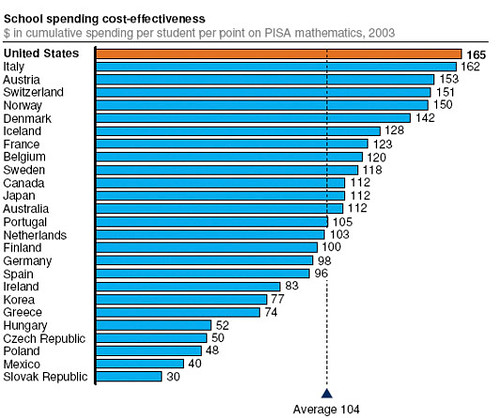
| + | <p>Unfortunately, throwing money at the system doesn%u2019t seem to help, either. As it is, the United States gets comparatively little bang for its buck on education spending. The United States spends more than any other country per point on the PISA math exam, and 60 percent more than the O.E.C.D. average:</p> | ||
| + | |||
| + | </blockquote> | ||
| + | <a href="http://www.flickr.com/photos/60472435@N00/3486681130" title="View 'edugraf' on Flickr.com"><img src="http://farm4.static.flickr.com/3325/3486681130_40d20f845d.jpg" alt="edugraf" border="0" width="500" height="418"></a> <a href="http://scienceblogs.com/neuronculture/2009/04/overpaying_for_educational_und.php#commentsArea">Read the comments on this post...</a><img src="http://feeds2.feedburner.com/~r/ScienceblogsChannelEducation/~4/pNXoRsoF7q8" height="1" width="1"></div> | ||
| + | <br></div></htm> | ||
Revision as of 08:16, 15 May 2009
<htm>Contents
- 1 <a href="http://eacea.ec.europa.eu/youth/tools/partner_search_en.php">Search and find Youth partners</a>
- 2 <a href="http://people.uis.edu/rschr1/onlinelearning/2009/04/institute-for-emerging-leadership-in.html">Institute for Emerging Leadership in Online Learning</a>
- 3 <a href="http://www.managesmarter.com/msg/content_display/training/e3i2fea4bd91d0d44f9411198cab5535630">Measurements for Evaluation and Management of the Training Department (PART 2 OF 4)</a>
- 4 <a href="http://people.uis.edu/rschr1/onlinelearning/2009/04/engaging-students-in-virtual-learning.html">Engaging Students in Virtual Learning - Denise Harrison, Campus Technology</a>
- 5 <a href="http://springwise.com/telecom_mobile/txteagle/">Quick tasks via SMS for phone users in the developing world</a>
- 6 <a href="http://people.uis.edu/rschr1/onlinelearning/2009/04/importance-of-teacher-professional.html">The Importance of Teacher Professional Development - Mary Ann Wolf, Huffington Post</a>
- 7 <a href="http://www.etf.europa.eu/Web.nsf/(RSS)/E65C8123E1782966C12575A7003907BF?OpenDocument&LAN=EN">ETF celebrates 15 years on Europe Day</a>
- 8 <a href="http://people.uis.edu/rschr1/onlinelearning/2009/04/please-sir-can-i-have-some-more.html">Please Sir, can I have some more… elearning, blended learning, wikis, forums, blogs? - Francis Marshall, Training Zone</a>
- 9 <a href="http://people.uis.edu/rschr1/onlinelearning/2009/04/five-questionsfor-george-siemens-lisa.html">FIVE QUESTIONS...For George Siemens - Lisa Neal Gualtieri, eLearn Magazine</a>
- 10 <a href="http://feedproxy.google.com/~r/ScienceblogsChannelEducation/~3/pNXoRsoF7q8/overpaying_for_educational_und.php">Overpaying for Educational Underachievement [Neuron Culture]</a>
<a href="http://eacea.ec.europa.eu/youth/tools/partner_search_en.php">Search and find Youth partners</a>
<a href="http://people.uis.edu/rschr1/onlinelearning/2009/04/institute-for-emerging-leadership-in.html">Institute for Emerging Leadership in Online Learning</a>
<a href="http://www.managesmarter.com/msg/content_display/training/e3i2fea4bd91d0d44f9411198cab5535630">Measurements for Evaluation and Management of the Training Department (PART
2 OF 4)</a>
<a href="http://people.uis.edu/rschr1/onlinelearning/2009/04/engaging-students-in-virtual-learning.html">Engaging Students in Virtual Learning - Denise Harrison, Campus Technology</a>
<a href="http://springwise.com/telecom_mobile/txteagle/">Quick tasks via SMS for phone users in the developing world</a>
<a href="http://www.springwise.com/telecom_mobile/txteagle/"><img src="http://www.springwise.com/pix/spotlight/txteagle.jpg"></a>
Both <a href="http://springwise.com/life_hacks/shorttask/">ShortTask</a> and <a href="https://www.mturk.com/mturk/welcome">Amazon's Mechanical Turk</a> enable Internet-connected computer users to earn money performing quick tasks for organizations far and wide. Now, a new project aims to bring similar income opportunities to those in the developing world using the ubiquitous mobile phone.
Targeting the more than 2 billion literate mobile phone subscribers in the developing world, <a href="http://www.txteagle.com">txteagle</a> aims to help alleviate high unemployment levels in many rural areas of countries like Kenya with a crowdsourcing approach that offers new ways to earn extra money. The service connects corporations with small tasks to be completed—currently, the most common ones include software localization and translation into local dialects for companies like Nokia—and native people who can complete them in minutes by cell phone. Tasks are sent to multiple phone users by text message—"translate the phrase, 'address book' into Giriama," for example—and answers are accepted as accurate when the majority of users provide the same response. Compensation is determined by the number of times an individual’s response agrees with the consensus; penalties are imposed for wrong answers, while "don’t know" responses make no contribution. Over time the system learns a particular user's expertise, and can actively select the most appropriate tasks for them. It can also weight answers from long-term and historically accurate users higher than others, making it necessary to involve fewer other individuals when those users respond. Payment is made either to a bank account connected with an individual's phone number—accessible at any post office or local kiosk—or via airtime credit transfers.
The txteagle service is currently deployed in Kenya via Mobile Planet and Safaricom, and will soon be launching in Rwanda through MTN Rwanda and in the Dominican Republic through Viva. Additional partnerships in Africa and South America will be announced later this year, txteagle says. Also in the works is a version of the service that uses the commonly found Unstructured Supplementary Service Data (USSD) protocol instead of SMS. One to partner with, try out or otherwise get involved in...?
Website: <a href="http://www.txteagle.com">www.txteagle.com</a>
Contact: <a href="mailto:info@txteagle.com">info@txteagle.com</a>
Spotted by: Susanna Haynie
<a href="http://people.uis.edu/rschr1/onlinelearning/2009/04/importance-of-teacher-professional.html">The Importance of Teacher Professional Development - Mary Ann Wolf, Huffington Post</a>
<a href="http://www.etf.europa.eu/Web.nsf/(RSS)/E65C8123E1782966C12575A7003907BF?OpenDocument&LAN=EN">ETF celebrates 15 years on Europe Day</a>
<a href="http://people.uis.edu/rschr1/onlinelearning/2009/04/please-sir-can-i-have-some-more.html">Please Sir, can I have some more… elearning, blended learning, wikis, forums, blogs? - Francis Marshall, Training Zone</a>
<a href="http://people.uis.edu/rschr1/onlinelearning/2009/04/five-questionsfor-george-siemens-lisa.html">FIVE QUESTIONS...For George Siemens - Lisa Neal Gualtieri, eLearn Magazine</a>
<a href="http://feedproxy.google.com/~r/ScienceblogsChannelEducation/~3/pNXoRsoF7q8/overpaying_for_educational_und.php">Overpaying for Educational Underachievement [Neuron Culture]</a>
As I've noted before, the U.S.'s health-care and education systems share some fundamental flaws: In both medical care and schooling we spend far more than other countries and get substandard results; in both cases, the overspending and poor results occur partly because our decentralized "systems" mean everyone does and measures everything differently, so you can't compare apples to oranges to even find out what works.
The folks at Economix <a href="http://economix.blogs.nytimes.com/2009/04/22/overpaying-for-educational-underachievement">look at this dynamic</a> in education from a return-on-investment perspective:
Education is a form of investment in a country%u2019s labor force and its overall economy. This means that educational shortcomings drag on economic growth. McKinsey estimates that:<a href="http://www.flickr.com/photos/60472435@N00/3486681130" title="View 'edugraf' on Flickr.com"><img src="http://farm4.static.flickr.com/3325/3486681130_40d20f845d.jpg" alt="edugraf" border="0" width="500" height="418"></a> <a href="http://scienceblogs.com/neuronculture/2009/04/overpaying_for_educational_und.php#commentsArea">Read the comments on this post...</a><img src="http://feeds2.feedburner.com/~r/ScienceblogsChannelEducation/~4/pNXoRsoF7q8" height="1" width="1">If the United States had in recent years closed the gap between its educational achievement levels and those of better-performing nations such as Finland and Korea, G.D.P. in 2008 could have been $1.3 trillion to $2.3 trillion higher. This represents 9 to 16 percent of G.D.P.
Similarly, if the United States had been able to narrow the achievement gap between white students and their black and Latino peers, the country%u2019s G.D.P. would have been an estimated $310 billion to $525 billion higher, or 2 to 4 percent of G.D.P.
Unfortunately, throwing money at the system doesn%u2019t seem to help, either. As it is, the United States gets comparatively little bang for its buck on education spending. The United States spends more than any other country per point on the PISA math exam, and 60 percent more than the O.E.C.D. average: