Difference between revisions of "Teoria e pratica della formazione"
m (added by Robot) |
m (added by Robot) |
||
| Line 1: | Line 1: | ||
| + | == Aggiornamento del 25/06/09 == | ||
| + | |||
| + | <htm><div class="news-item"><div style="font-family:sans-serif;overflow:auto;width:100%;margin: 0px 10px"><h2 style="margin: 0.25em 0 0 0"><div class=""><a href="http://feeds.informationweek.com/click.phdo?i=db2bcfa0dd84c226bce8b2c932430fbd">Enterprise 2.0: Making Virtual Collaboration Work</a></div></h2> | ||
| + | <div style="margin-bottom: 0.5em">via <a href="http://www.informationweek.com/" class="f">InformationWeek - All Stories</a> on 6/25/09</div><br style="display:none"> | ||
| + | A Volvo team's online collaboration experiences demonstrate the importance of finding a human side to virtual teams. | ||
| + | |||
| + | |||
| + | |||
| + | |||
| + | |||
| + | <br style="clear:both"> | ||
| + | <br style="clear:both"> | ||
| + | <a href="http://ads.pheedo.com/click.phdo?s=db2bcfa0dd84c226bce8b2c932430fbd&p=1"><img alt="" style="border:0" border="0" src="http://ads.pheedo.com/img.phdo?s=db2bcfa0dd84c226bce8b2c932430fbd&p=1"></a></div> | ||
| + | <br></div></htm> | ||
| + | |||
| + | <htm><div class="news-item"><div style="font-family:sans-serif;overflow:auto;width:100%;margin: 0px 10px"><h2 style="margin: 0.25em 0 0 0"><div class=""><a href="http://feedproxy.google.com/~r/ScienceblogsChannelEducation/~3/mcNbMifBKqU/i_dont_believe_in_colleges_and.php">I don't believe in colleges and universities, I believe in libraries | ||
| + | [Confessions of a Science Librarian]</a></div></h2> | ||
| + | <div style="margin-bottom: 0.5em">via <a href="http://www.scienceblogs.com/channel/education/" class="f">ScienceBlogs Channel : Education</a> by John Dupuis none@example.com on 6/24/09</div><br style="display:none"> | ||
| + | <p>A thought experiment.</p> | ||
| + | |||
| + | <p>It all started with this <a href="http://www.nytimes.com/2009/06/20/us/20ventura.html?_r=1&hpw">Ray Bradbury quote in the New York Times</a>:<br> | ||
| + | <blockquote>"Libraries raised me," Mr. Bradbury said. "<strong>I don't believe in colleges and universities. I believe in libraries</strong> because most students don't have any money. When I graduated from high school, it was during the Depression and we had no money. I couldn't go to college, so I went to the library three days a week for 10 years."</blockquote><br> | ||
| + | I've bolded the chunk that has resonated most strongly around the Internet, especially Twitter where it was widely tweeted and retweeted.</p> | ||
| + | |||
| + | <p>The <a href="http://twitter.com/timoreilly/statuses/2256201875">tweeter that most piqued my interest was Tim O'Reilly</a>, publisher of O'Reilly Books and all-round Web 2.0/Twitter Rockstar.</p> | ||
| + | |||
| + | <p>Now, I poked around a little on the web and on Twitter and as far as I could tell, O'Reilly has never really shown much interest in libraries or librarians before. Which is fine. Personally, I love his books, Safari is a great product for libraries and got it about digital books very early in the game. His view of publishing is very progressive and geared to an all-digital future, he's certainly at the forefront of trying to figure out a business model for technical book publishing. I buy a lot of O'Reilly books for my collection and I first got us on board with a Safari subscription for York 5 or 6 years ago. (Note to self: do this year's Safari title selections soon.)</p> | ||
| + | |||
| + | <p>So what drew him to Bradbury's comment, and what resonated about that comment among so many of his followers that <a href="http://twitter.com/#search?q=%20timoreilly%20libraries">caused them to retweet</a>?</p> | ||
| + | |||
| + | <p><strong>I don't believe in colleges and universities. I believe in libraries.</strong></p> | ||
| + | |||
| + | <p>I do have some thoughts on the issue and I think it revolves around having faith in content rather than institutions.</p> | ||
| + | |||
| + | <p>I suspect O'Reilly may have associated libraries less with their institutional nature than with our large collections of content that are freely available to our patron communities. Libraries are thought of as places where people can engage with information, knowledge and ideas, to learn independently and freely, to follow their own muses to where great books and literature take them.</p> | ||
| + | |||
| + | <p>Whereas colleges and universities are thought of as large, impersonal, factory-like institutions, slow to change, ivory towers that are closed to all but a few. They focus narrowly on branding and certification rather than true knowledge and learning -- sausage factories of the mind.</p> | ||
| + | |||
| + | <p>You learn in libraries. You are taught in colleges and universities. Active vs. passive.</p> | ||
| + | |||
| + | <p>Now, I don't believe either of these facile characterizations for a minute, and I could easily reverse them to make colleges & universities come out smelling like roses and libraries, not so much. But I do think that might be the dynamic that caught people's attention, and certainly someone like Tim O'Reilly sees his future bound up in making content available outside of institutional confines.</p> | ||
| + | |||
| + | <p>But it's an interesting way to look at things: content vs. institutions.</p> | ||
| + | |||
| + | <p>(It's worth noting that I definitely believe in both IHEs and libraries; I also believe in the vital role of libraries in those institutions.)</p> <a href="http://scienceblogs.com/confessions/2009/06/i_dont_believe_in_colleges_and.php#commentsArea">Read the comments on this post...</a><img src="http://feeds.feedburner.com/~r/ScienceblogsChannelEducation/~4/mcNbMifBKqU" height="1" width="1"></div> | ||
| + | <br></div></htm> | ||
| + | |||
== Aggiornamento del 16/06/09 == | == Aggiornamento del 16/06/09 == | ||
Revision as of 21:22, 25 June 2009
Contents
- 1 Aggiornamento del 25/06/09
- 2 <a href="http://feeds.informationweek.com/click.phdo?i=db2bcfa0dd84c226bce8b2c932430fbd">Enterprise 2.0: Making Virtual Collaboration Work</a>
- 3 <a href="http://feedproxy.google.com/~r/ScienceblogsChannelEducation/~3/mcNbMifBKqU/i_dont_believe_in_colleges_and.php">I don't believe in colleges and universities, I believe in libraries [Confessions of a Science Librarian]</a>
- 4 Aggiornamento del 16/06/09
- 5 <a href="http://people.uis.edu/rschr1/onlinelearning/2009/06/peercasting-students-produce-math.html">Peercasting: Students Produce Math Support at NC Middle School - Bridget McCrea, THE Journal</a>
- 6 <a href="http://people.uis.edu/rschr1/onlinelearning/2009/06/securing-online-learning-at-tulsa-tech.html">Securing Online Learning at Tulsa Tech - Dian Schaffhauser, THE Journal</a>
- 7 <a href="http://people.uis.edu/rschr1/onlinelearning/2009/06/influence-of-experience-ability-and.html">The Influence of Experience, Ability and Interest on e-learning Effectiveness - Matti Haverila & Reza Barkhi, EURODL</a>
- 8 <a href="http://cordis.europa.eu/search/index.cfm?fuseaction=proj.document&PJ_LANG=EN&PJ_RCN=9465963">A targeted action to support trans-national innovation policy learning</a>
- 9 <a href="http://feedproxy.google.com/~r/ScienceblogsChannelEducation/~3/NCon81H8PtM/video_video_video_video.php">Video, video, video (video) [A Blog Around The Clock]</a>
- 10 <a href="http://www.computerworld.com/action/article.do?command=viewArticleBasic&articleId=9134027&source=rss_news">How cell phones will replace learning</a>
- 11 <a href="http://www.zylstra.org/blog/archives/2009/06/rotterdam_unive.html">Rotterdam University Learning Community Results</a>
- 12 <a href="http://people.uis.edu/rschr1/onlinelearning/2009/06/rise-of-virtual-classroom-david-henke.html">The rise of the virtual classroom - DAVID HENKE, Northfield News</a>
- 13 <a href="http://people.uis.edu/rschr1/onlinelearning/2009/06/online-learning-classes-create-demand.html">Online learning classes create demand for do-it-at-home lab kits - George Plaven, The Denver Post</a>
- 14 <a href="http://www.cnr.it/cnr/events/CnrEventi?IDn=1942">Giornata di studi: "Documentazione, terminologia e scienze dell'informazione. Una riflessione sull'interrelazione cognitiva delle scienze del testo e del documento"</a>
- 15 <a href="http://www.managesmarter.com/msg/content_display/training/e3i0fe06f39ca1404322beda64e79bf46c3">The Training World is Wide Open</a>
- 16 <a href="http://www.ft.com/businesseducation/future-of-business-schools">Reinventing the MBA</a>
- 17 <a href="http://people.uis.edu/rschr1/onlinelearning/2009/06/five-things-to-look-for-in-online.html">Five things to look for in an online school - Audie Rubin, Your Hub Denver</a>
- 18 <a href="http://people.uis.edu/rschr1/onlinelearning/2009/06/online-learning-virtual-school.html">Online Learning: Virtual school implements game-based course - eSchool News</a>
- 19 <a href="http://www.mywire.com/a/AFP/California-schoolbooks-going-digital/10917123">California schoolbooks going digital</a>
- 20 <a href="http://www.etf.europa.eu/web.nsf/pages/Events_EN?OpenDocument&emb=http://www.etf.europa.eu/EventsMgmt.nsf/(RSS)/A2057D54A90C59DAC12575D1002E8458?OpenDocument&LAN=EN">Event: 25/06/2009 - Certification and recognition of formal and informal learning: top priorities for adults’ education and training</a>
- 21 <a href="http://www.computerworld.com/action/article.do?command=viewArticleBasic&articleId=9134271&source=rss_news">Why Even Successful Speakers Need To Practice</a>
- 22 <a href="http://feedproxy.google.com/~r/tedtalks_audio/~3/gqYTcycYX_A/571">TEDTalks : Robert Full: Learning from the gecko's tail - Robert Full (2009)</a>
- 23 Aggiornamento del 05/06/09
- 24 <a href="http://www.managesmarter.com/msg/content_display/training/e3ia4b7dd4f31026b7e2a499508c3b310f5">A Formula to Make Learning and Development Stick</a>
- 25 <a href="http://people.uis.edu/rschr1/onlinelearning/2009/06/all-hail-future-aparna-nancherla.html">All Hail the Future! - Aparna Nancherla, Training + Development</a>
- 26 <a href="http://people.uis.edu/rschr1/onlinelearning/2009/06/online-learning-jisc-welcomes-vision.html">Online Learning: JISC welcomes vision for Higher Education in a Web 2.0 world - Public Technology UK</a>
- 27 <a href="http://www.mywire.com/a/HuffingtonPost/Can-You-Teach-Creative-Writing/10762339">Can You Teach Creative Writing?</a>
- 28 <a href="http://www.smallbusiness.co.uk/channels/employing-staff/news/1048976/uk-needs-microbusiness-skills-council.thtml">UK 'needs micro-business skills council'</a>
- 29 <a href="http://people.uis.edu/rschr1/onlinelearning/2009/06/online-learning-escience-in-practice.html">Online Learning: EScience in Practice - William Y. Arms, Manuel Calimlim & Lucia Walle; D-Lib Magazine</a>
- 30 <a href="http://people.uis.edu/rschr1/onlinelearning/2009/06/twitter-goes-to-college-zach-miners-us.html">Twitter goes to college - Zach Miners, US News and World Report</a>
- 31 <a href="http://people.uis.edu/rschr1/onlinelearning/2009/06/online-learning-bryant-stratton-to-hold.html">Online Learning: Bryant & Stratton To Hold Graduation in Second Life for Online Students - Dian Schaffhauser, Campus Technology</a>
- 32 Aggiornamento del 15/05/09
- 33 <a href="http://eacea.ec.europa.eu/youth/tools/partner_search_en.php">Search and find Youth partners</a>
- 34 <a href="http://people.uis.edu/rschr1/onlinelearning/2009/04/institute-for-emerging-leadership-in.html">Institute for Emerging Leadership in Online Learning</a>
- 35 <a href="http://www.managesmarter.com/msg/content_display/training/e3i2fea4bd91d0d44f9411198cab5535630">Measurements for Evaluation and Management of the Training Department (PART 2 OF 4)</a>
- 36 <a href="http://people.uis.edu/rschr1/onlinelearning/2009/04/engaging-students-in-virtual-learning.html">Engaging Students in Virtual Learning - Denise Harrison, Campus Technology</a>
- 37 <a href="http://springwise.com/telecom_mobile/txteagle/">Quick tasks via SMS for phone users in the developing world</a>
- 38 <a href="http://people.uis.edu/rschr1/onlinelearning/2009/04/importance-of-teacher-professional.html">The Importance of Teacher Professional Development - Mary Ann Wolf, Huffington Post</a>
- 39 <a href="http://www.etf.europa.eu/Web.nsf/(RSS)/E65C8123E1782966C12575A7003907BF?OpenDocument&LAN=EN">ETF celebrates 15 years on Europe Day</a>
- 40 <a href="http://people.uis.edu/rschr1/onlinelearning/2009/04/please-sir-can-i-have-some-more.html">Please Sir, can I have some more… elearning, blended learning, wikis, forums, blogs? - Francis Marshall, Training Zone</a>
- 41 <a href="http://people.uis.edu/rschr1/onlinelearning/2009/04/five-questionsfor-george-siemens-lisa.html">FIVE QUESTIONS...For George Siemens - Lisa Neal Gualtieri, eLearn Magazine</a>
- 42 <a href="http://feedproxy.google.com/~r/ScienceblogsChannelEducation/~3/pNXoRsoF7q8/overpaying_for_educational_und.php">Overpaying for Educational Underachievement [Neuron Culture]</a>
- 43 <a href="http://ec.europa.eu/enterprise/e_i/news/article_8903_en.htm">Showcasing regional innovation</a>
- 44 <a href="http://ec.europa.eu/enterprise/newsroom/cf/itemshortdetail.cfm?item_id=3080">Conference ''Tourism Industry: Employment and Labour Market Challenges''</a>
- 45 <a href="http://www.istat.it/salastampa/comunicati/non_calendario/20090430_00">I nuovi indici del lavoro e delle retribuzioni nelle grandi imprese in base 2005 e Ateco 2007</a>
- 46 <a href="http://ec.europa.eu/enterprise/newsroom/cf/itemlongdetail.cfm?item_id=3083">Modernisation of EU research funding on the right track - Questions and Answers</a>
- 47 <a href="http://people.uis.edu/rschr1/onlinelearning/2009/05/schools-tools-teaching-tech-savvy.html">Schools’ tools teaching tech-savvy generation - CLAIRE MILLER, Gainesville Times</a>
- 48 <a href="http://www.etf.europa.eu/Web.nsf/(RSS)/321D09D95C8B2D01C12575AE002B3A02?OpenDocument&LAN=EN">Mutual learning puts you in the driving seat</a>
- 49 <a href="http://people.uis.edu/rschr1/onlinelearning/2009/05/employer-perceptions-of-online-degrees.html">Employer Perceptions of Online Degrees: A Literature Review - Norina L. Columbaro & Catherine H. Monaghan, OJDLA</a>
- 50 <a href="http://www.etf.europa.eu/Web.nsf/(RSS)/301E3A81898EC6EEC12575A80050E266?OpenDocument&LAN=EN">New ETF project to promote mutual learning</a>
- 51 <a href="http://eacea.ec.europa.eu/llp/funding/2009/call_nlls_2009.html">Support for European cooperation in Education and Training - Call for proposals</a>
- 52 <a href="http://eacea.ec.europa.eu/llp/funding/2009/call_eqf_2009.html">European Qualifications Framework (EQF) - Call for proposals</a>
- 53 <a href="http://www.etf.europa.eu/Web.nsf/pages/Events_EN?OpenDocument&emb=http://www.etf.europa.eu/EventsMgmt.nsf/(RSS)/D7FCF1743B46397FC125757F0046ACC7?OpenDocument&LAN=EN">Event: 27/05/2009 - LEARN project Study Visit to CPI, Slovenia - From ‘best practice’ to ‘next practice’</a>
- 54 <a href="http://people.uis.edu/rschr1/onlinelearning/2009/05/stimulus-aims-to-help-close-digital.html">Stimulus aims to help close digital divide for online learning and more - Maya T. Prabhu, eSchool News</a>
- 55 <a href="http://europa.eu/rapid/pressReleasesAction.do?reference=IP/09/714&format=HTML&aged=0&language=IT&guiLanguage=en">Praga celebra la III edizione del Premio Europeo per l’apprendimento permanente</a>
- 56 <a href="http://people.uis.edu/rschr1/onlinelearning/2009/05/how-to-become-successful-online-learner.html">How to become a successful online learner - Lauri Harrison, Global Campus Examiner</a>
- 57 <a href="http://feedproxy.google.com/~r/TEDTalks_audio/~3/9H4SFrRfPxs/533">TEDTalks : A bold vision for teaching arts and sciences -- together - Mae Jemison (2002)</a>
- 58 <a href="http://europa.eu/rapid/pressReleasesAction.do?reference=IP/09/739&format=HTML&aged=0&language=IT&guiLanguage=en">Le scuole europee si rinnovano</a>
Aggiornamento del 25/06/09
<htm><a href="http://feeds.informationweek.com/click.phdo?i=db2bcfa0dd84c226bce8b2c932430fbd">Enterprise 2.0: Making Virtual Collaboration Work</a>
A Volvo team's online collaboration experiences demonstrate the importance of finding a human side to virtual teams.
<a href="http://feedproxy.google.com/~r/ScienceblogsChannelEducation/~3/mcNbMifBKqU/i_dont_believe_in_colleges_and.php">I don't believe in colleges and universities, I believe in libraries
[Confessions of a Science Librarian]</a>
A thought experiment.
It all started with this <a href="http://www.nytimes.com/2009/06/20/us/20ventura.html?_r=1&hpw">Ray Bradbury quote in the New York Times</a>:
"Libraries raised me," Mr. Bradbury said. "I don't believe in colleges and universities. I believe in libraries because most students don't have any money. When I graduated from high school, it was during the Depression and we had no money. I couldn't go to college, so I went to the library three days a week for 10 years."
I've bolded the chunk that has resonated most strongly around the Internet, especially Twitter where it was widely tweeted and retweeted.
The <a href="http://twitter.com/timoreilly/statuses/2256201875">tweeter that most piqued my interest was Tim O'Reilly</a>, publisher of O'Reilly Books and all-round Web 2.0/Twitter Rockstar.
Now, I poked around a little on the web and on Twitter and as far as I could tell, O'Reilly has never really shown much interest in libraries or librarians before. Which is fine. Personally, I love his books, Safari is a great product for libraries and got it about digital books very early in the game. His view of publishing is very progressive and geared to an all-digital future, he's certainly at the forefront of trying to figure out a business model for technical book publishing. I buy a lot of O'Reilly books for my collection and I first got us on board with a Safari subscription for York 5 or 6 years ago. (Note to self: do this year's Safari title selections soon.)
So what drew him to Bradbury's comment, and what resonated about that comment among so many of his followers that <a href="http://twitter.com/#search?q=%20timoreilly%20libraries">caused them to retweet</a>?
I don't believe in colleges and universities. I believe in libraries.
I do have some thoughts on the issue and I think it revolves around having faith in content rather than institutions.
I suspect O'Reilly may have associated libraries less with their institutional nature than with our large collections of content that are freely available to our patron communities. Libraries are thought of as places where people can engage with information, knowledge and ideas, to learn independently and freely, to follow their own muses to where great books and literature take them.
Whereas colleges and universities are thought of as large, impersonal, factory-like institutions, slow to change, ivory towers that are closed to all but a few. They focus narrowly on branding and certification rather than true knowledge and learning -- sausage factories of the mind.
You learn in libraries. You are taught in colleges and universities. Active vs. passive.
Now, I don't believe either of these facile characterizations for a minute, and I could easily reverse them to make colleges & universities come out smelling like roses and libraries, not so much. But I do think that might be the dynamic that caught people's attention, and certainly someone like Tim O'Reilly sees his future bound up in making content available outside of institutional confines.
But it's an interesting way to look at things: content vs. institutions.
(It's worth noting that I definitely believe in both IHEs and libraries; I also believe in the vital role of libraries in those institutions.)
<a href="http://scienceblogs.com/confessions/2009/06/i_dont_believe_in_colleges_and.php#commentsArea">Read the comments on this post...</a><img src="http://feeds.feedburner.com/~r/ScienceblogsChannelEducation/~4/mcNbMifBKqU" height="1" width="1">Aggiornamento del 16/06/09
<htm><a href="http://people.uis.edu/rschr1/onlinelearning/2009/06/peercasting-students-produce-math.html">Peercasting: Students Produce Math Support at NC Middle School - Bridget McCrea, THE Journal</a>
<a href="http://people.uis.edu/rschr1/onlinelearning/2009/06/securing-online-learning-at-tulsa-tech.html">Securing Online Learning at Tulsa Tech - Dian Schaffhauser, THE Journal</a>
<a href="http://people.uis.edu/rschr1/onlinelearning/2009/06/influence-of-experience-ability-and.html">The Influence of Experience, Ability and Interest on e-learning Effectiveness - Matti Haverila & Reza Barkhi, EURODL</a>
<a href="http://cordis.europa.eu/search/index.cfm?fuseaction=proj.document&PJ_LANG=EN&PJ_RCN=9465963">A targeted action to support trans-national innovation policy learning</a>
Quality validation date:
<a href="http://feedproxy.google.com/~r/ScienceblogsChannelEducation/~3/NCon81H8PtM/video_video_video_video.php">Video, video, video (video) [A Blog Around The Clock]</a>
Of course the Course description for JOMC 449 - Virtual Communities, Smart Mobs, Citizen Journalism and Participatory Culture is made in video. All the 'readings' are viewings of video, all assignments are video-making. So cool!
<embed src="http://www.youtube.com/v/73dSGdGO1x0&hl=en&fs=1&color1=0x006699&color2=0x54abd6" allowScriptAccess="never" allowFullScreen="true" width="425" height="344" wmode="transparent" type="application/x-shockwave-flash"></embed>
Fall 2009 MW 3:30 - 4:45, UNC Chapel Hill, Instructor: Paul Jones
<a href="http://scienceblogs.com/clock/2009/06/video_video_video_video.php#commentsArea">Read the comments on this post...</a><img src="http://feeds2.feedburner.com/~r/ScienceblogsChannelEducation/~4/NCon81H8PtM" height="1" width="1"><a href="http://www.computerworld.com/action/article.do?command=viewArticleBasic&articleId=9134027&source=rss_news">How cell phones will replace learning</a>
<a href="http://www.zylstra.org/blog/archives/2009/06/rotterdam_unive.html">Rotterdam University Learning Community Results</a>
<a href="http://www.flickr.com/photos/tonz/3600394182/" title="Rethink! by TonZ, on Flickr"><img src="http://farm4.static.flickr.com/3376/3600394182_b7a485f8c1_m.jpg" alt="Rethink!" align="left" border="0" height="240" hspace="5" vspace="5" width="218"></a>Almost exactly a year ago I <a href="http://www.zylstra.org/blog/archives/2008/06/community_of_pr.html">wrote here about a project</a> I had embarked on at Rotterdam University with a group of a dozen or so teachers:
The aim is to let the members explore and learn in a self-steered setting, as a diversification of the internal training methods they have on offer for their employees. Subject matter is how to adapt their teaching to the digital reality their students are already living in, and the digital reality in place in the fields of work they are educating their students for.
We spent a full year exploring and Freddy Veltman worked with us the entire year, as we were her subject of empirical study for her PhD research into how professionals develop themselves. My own role was as designer of the original work format, as facilitator to the group and moderator in the group's online platform, and as subject matter expert for all things social media.
Last Thursday all members of the group presented their work to colleagues and management. A project that has been very dear to me has now ended. Time to look back for a bit.
The Big Five
During the year we realized as a group we were getting results and learning things in five different areas, that were relevant to Rotterdam University. These five areas were dubbed The Big Five by one of the group members, and the term immediately stuck:
Authenticity (Bringing your teaching as close as possible to reality. Real problems, real results, real work formats, making everything count.)
Co-creation (Involving both your students and colleagues in each and every stage of both development and execution of your teaching modules.)
Competences (What's needed for a teacher with regard to the first two points, and to do your own exploratory and networked learning as a teacher)
Knowledge Creation (What we learned that can be packaged for others and can be transferred to others in the organisation)
Work Form (How the free format self-steered learning group worked for us, how it can be used both in teaching as well as in growing professionally)
There is a lot to say about the five points above, but that warrants multiple posts, so I will not go into it now. In stead I want to focus on the effect the project had on the participants and on their students.
Informal meet-up this spring, Working session (by <a href="http://www.flickr.com/photos/nlanja/">Anja</a>)
Change your work, change yourself
I doubt that at the start the participants knew what they were getting themselves into. Most of them thought they embarked on a project to modernize their teaching. But all, including me and the project manager, ended up (re-)shaping our skills and our attitudes in unexpected ways. I'll let a few quotes taken from the final interviews with group members speak for themselves.
"I rediscovered the fun of learning. I learned that merely working to improve my teaching is a boost in enjoying my work and be motivated all by itself."
"Doing things, acting on thoughts, gives a lot of space in my mind"
"I now have the guts to experiment."
"I am sad that I don't get to lecture as much anymore, I enjoyed that so much. But I am now much more involved with my students, much more in touch with them. I've started loving my students so much more."
"The relief of being able to ask anything in the group, however small or 'stupid'. All questions were good questions."
"I've lost my fear of technology, my fear of making mistakes using technology."
"I was brought up to be modest, to think that sharing was exhibitionist. I've learned to share so much more."
"Glad we had an entire year. Real change needs time."
"I came to change my teaching module, I left having changed my world."
"I feel closer to my colleagues and to my students. The contact is much more real."
"I've learned to own my work. My primary concern are my students, everything else is secondary. I would get away with doing much less, but that would make me feel completely miserable."
"It's been over 35 years I had so much fun learning so much."
"It's amazing to learn from and connect to people all around the world. It's inconceivable how much that means to me."
"I almost exhausted myself in the first months. Spending time on this project until 2 or 3 am. But I needed to."
"This project made my entire job much more fun. The space and freedom to explore and experiment."
The list goes on. Mind you, this is all irrespective of the fact that it has been a bumpy ride for the group at times. Harsh words have been exchanged between members, frustrations and tempers flared. This was no walk in the park.
Change your work, change your students
Group members also have a lot to tell about how changing the teaching modules, changing their own teaching skills and attitudes, impacted their students and the results the students achieved. In general appreciation for the courses went up, results stayed the same or went up as well. Especially for those modules where books and theoretical material were dealt with as resources while immediately applying that knowledge in the course. Students found themselves more challenged, more involved and having more understanding of the role of the teacher. Again a few quotes, from both teachers and students to wet your appetite:
"My students don't miss my lecturing at all."
"It's amazing what you get back from your students when you let go."
"Being open to my students that I am experimenting myself, actively inviting their feedback, and the amount of recognition you get from that."
"When I met a student some time later, and asked her how the course I adapted had effect on her, she started to cry."
"Amazing what we learned in three weeks. I now understand so much better what my future profession is about."
Me and Jet working, group working session (both by <a href="http://www.flickr.com/photos/ecphaff/">Ernst</a>),
I'll go into results on the Big Five and examples more in consequent postings. I feel privileged to have been part of this project.
Technorati Tags: <a href="http://technorati.com/tag/hzap08" rel="tag">hzap08</a>, <a href="http://technorati.com/tag/communityofpractice" rel="tag">communityofpractice</a>, <a href="http://technorati.com/tag/learningcommunity" rel="tag">learningcommunity</a>, <a href="http://technorati.com/tag/hogeschoolrotterdam" rel="tag">hogeschoolrotterdam</a>
<a href="http://people.uis.edu/rschr1/onlinelearning/2009/06/rise-of-virtual-classroom-david-henke.html">The rise of the virtual classroom - DAVID HENKE, Northfield News</a>
<a href="http://people.uis.edu/rschr1/onlinelearning/2009/06/online-learning-classes-create-demand.html">Online learning classes create demand for do-it-at-home lab kits - George Plaven, The Denver Post</a>
<a href="http://www.cnr.it/cnr/events/CnrEventi?IDn=1942">Giornata di studi: "Documentazione, terminologia e scienze
dell'informazione. Una riflessione sull'interrelazione cognitiva delle
scienze del testo e del documento"</a>
dell'informazione. Una riflessione sull'interrelazione cognitiva delle
scienze del testo e del documento"</a>Periodo: 12/06/2009
Città: Roma
Luogo: aula Marconi del CNR, piazzale Aldo Moro, 7
Oggetto: Giornata di studi: "Documentazione, terminologia e scienze dell'informazione. Una riflessione sull'interrelazione cognitiva delle scienze del testo e del documento"
Abstract: Organizzata dalla Società Italiana di Documentazione Avanzata, dal Laboratorio di Documentazione dell'Università di Calabria e il Servizio Gestione dei Documenti del CNR<p> <p>Riferimenti: Paolo De Gasperis, Servizio Gestione dei Documenti del CNR tel. 06/49933225 - 3165; e mail: paolo.degasperis@cnr.it
</p></p><a href="http://www.managesmarter.com/msg/content_display/training/e3i0fe06f39ca1404322beda64e79bf46c3">The Training World is Wide Open</a>
<a href="http://www.ft.com/businesseducation/future-of-business-schools">Reinventing the MBA</a>
<a href="http://people.uis.edu/rschr1/onlinelearning/2009/06/five-things-to-look-for-in-online.html">Five things to look for in an online school - Audie Rubin, Your Hub Denver</a>
The number of districts, schools and institutions that offer online learning opportunities seems to be growing at a blazing pace as well. It can be difficult for parents and students to evaluate all the options available to them. Here are five things to look for when trying to find the best online learning opportunity.
<a href="http://people.uis.edu/rschr1/onlinelearning/2009/06/online-learning-virtual-school.html">Online Learning: Virtual school implements game-based course - eSchool News</a>
<a href="http://www.mywire.com/a/AFP/California-schoolbooks-going-digital/10917123">California schoolbooks going digital</a>
SAN FRANCISCO (AFP) — California Governor Arnold Schwarzenegger has announced plans to phase out school textbooks in favor of digital learning aids as the state looks to plug its massive budget hole.
(The full text of this article is available free)
<a href="http://www.etf.europa.eu/web.nsf/pages/Events_EN?OpenDocument&emb=http://www.etf.europa.eu/EventsMgmt.nsf/(RSS)/A2057D54A90C59DAC12575D1002E8458?OpenDocument&LAN=EN">Event: 25/06/2009 - Certification and recognition of formal and informal
learning: top priorities for adults’ education and training</a>
This seminar is a follow up of the previous event organised in January 2009, which was aimed at presenting and discussing ETF feasibility study on adult learning, within the context of an overall policy for human capital development. During the implementation of the study and the January’s event, certification and validation of learning have been identified as key topics to consider when developing an adult learning strategy.
The seminar will therefore be aimed at analysing the situation in Bosnia and Herzegovina, through the presentation from the institutions and the employers and to bring as well the experience from other countries where the system is quite well advanced like the case of France. The presentation will show why it is so crucial to have the employers involved since the very beginning of the process in a pro-active way in identifying and designing the relevant certificates and the appropriate procedures for certification. It will be also important to discuss these issues in the context of developments of the European policy in education and training as well as the support that Bosnia and Herzegovina will receive through the implementation of EC IPA funded projects aimed at developing and adult learning strategy and adult learning law and piloting some training initiatives.<a href="http://www.computerworld.com/action/article.do?command=viewArticleBasic&articleId=9134271&source=rss_news">Why Even Successful Speakers Need To Practice</a>
<a href="http://feedproxy.google.com/~r/tedtalks_audio/~3/gqYTcycYX_A/571">TEDTalks : Robert Full: Learning from the gecko's tail - Robert Full (2009)</a>
Aggiornamento del 05/06/09
<htm><a href="http://www.managesmarter.com/msg/content_display/training/e3ia4b7dd4f31026b7e2a499508c3b310f5">A Formula to Make Learning and Development Stick</a>
<a href="http://people.uis.edu/rschr1/onlinelearning/2009/06/all-hail-future-aparna-nancherla.html">All Hail the Future! - Aparna Nancherla, Training + Development</a>
<a href="http://people.uis.edu/rschr1/onlinelearning/2009/06/online-learning-jisc-welcomes-vision.html">Online Learning: JISC welcomes vision for Higher Education in a Web 2.0 world - Public Technology UK</a>
<a href="http://www.mywire.com/a/HuffingtonPost/Can-You-Teach-Creative-Writing/10762339">Can You Teach Creative Writing?</a>
Creative-writing programs are designed on the theory that students who have never published a poem can teach other students who have never published a poem how to write a publishable poem.
(The full text of this article is available free)
<a href="http://www.smallbusiness.co.uk/channels/employing-staff/news/1048976/uk-needs-microbusiness-skills-council.thtml">UK 'needs micro-business skills council'</a>
A designated Small Business Sector Skills Council is needed to help the UK's smallest companies.
The Federation of Small Businesses (FSB) claims that micro-businesses, or those which employ less than five people, are currently excluded from the government's training programmes.
Research by the group shows that 88 per cent of micro-firms had not benefited from the Train to Gain scheme because they are not aware of it or believe they will not qualify, despite a £350 million pot being set aside to help the country's smallest enterprises.
Furthermore, 78 per cent call for the government training programmes to be more flexible and provide education in specialist areas such as health and safety, IT, marketing and other essential business management skills.
Colin Willman, FSB education and skills chairman, says that companies which employ a small number of people should not have to send them out of the workplace to meet their training needs.
'What we really need is dedicated training for the smallest firms, in the form of a new Small Business Sector Skills Council,' he adds.
Last month, the Department for Innovation, Universities and Skills revealed that £11 million has been invested in creating almost 3,000 new apprenticeships.
<a href="http://people.uis.edu/rschr1/onlinelearning/2009/06/online-learning-escience-in-practice.html">Online Learning: EScience in Practice - William Y. Arms, Manuel Calimlim & Lucia Walle; D-Lib Magazine</a>
<a href="http://people.uis.edu/rschr1/onlinelearning/2009/06/twitter-goes-to-college-zach-miners-us.html">Twitter goes to college - Zach Miners, US News and World Report</a>
At the University of Texas-Dallas, history professor Monica Rankin needed a better way to get students involved in the classroom. The 90-person lecture hall was too big for back-and-forth conversation. So, with help from students in the school's emerging media program, she had her students set up accounts on Twitter—a micro-blogging service—and then use the technology to post messages and ask questions that were displayed on a projector screen during class.
<a href="http://people.uis.edu/rschr1/onlinelearning/2009/06/online-learning-bryant-stratton-to-hold.html">Online Learning: Bryant & Stratton To Hold Graduation in Second Life for Online Students - Dian Schaffhauser, Campus Technology</a>
Aggiornamento del 15/05/09
<htm><a href="http://eacea.ec.europa.eu/youth/tools/partner_search_en.php">Search and find Youth partners</a>
<a href="http://people.uis.edu/rschr1/onlinelearning/2009/04/institute-for-emerging-leadership-in.html">Institute for Emerging Leadership in Online Learning</a>
<a href="http://www.managesmarter.com/msg/content_display/training/e3i2fea4bd91d0d44f9411198cab5535630">Measurements for Evaluation and Management of the Training Department (PART
2 OF 4)</a>
<a href="http://people.uis.edu/rschr1/onlinelearning/2009/04/engaging-students-in-virtual-learning.html">Engaging Students in Virtual Learning - Denise Harrison, Campus Technology</a>
<a href="http://springwise.com/telecom_mobile/txteagle/">Quick tasks via SMS for phone users in the developing world</a>
<a href="http://www.springwise.com/telecom_mobile/txteagle/"><img src="http://www.springwise.com/pix/spotlight/txteagle.jpg"></a>
Both <a href="http://springwise.com/life_hacks/shorttask/">ShortTask</a> and <a href="https://www.mturk.com/mturk/welcome">Amazon's Mechanical Turk</a> enable Internet-connected computer users to earn money performing quick tasks for organizations far and wide. Now, a new project aims to bring similar income opportunities to those in the developing world using the ubiquitous mobile phone.
Targeting the more than 2 billion literate mobile phone subscribers in the developing world, <a href="http://www.txteagle.com">txteagle</a> aims to help alleviate high unemployment levels in many rural areas of countries like Kenya with a crowdsourcing approach that offers new ways to earn extra money. The service connects corporations with small tasks to be completed—currently, the most common ones include software localization and translation into local dialects for companies like Nokia—and native people who can complete them in minutes by cell phone. Tasks are sent to multiple phone users by text message—"translate the phrase, 'address book' into Giriama," for example—and answers are accepted as accurate when the majority of users provide the same response. Compensation is determined by the number of times an individual’s response agrees with the consensus; penalties are imposed for wrong answers, while "don’t know" responses make no contribution. Over time the system learns a particular user's expertise, and can actively select the most appropriate tasks for them. It can also weight answers from long-term and historically accurate users higher than others, making it necessary to involve fewer other individuals when those users respond. Payment is made either to a bank account connected with an individual's phone number—accessible at any post office or local kiosk—or via airtime credit transfers.
The txteagle service is currently deployed in Kenya via Mobile Planet and Safaricom, and will soon be launching in Rwanda through MTN Rwanda and in the Dominican Republic through Viva. Additional partnerships in Africa and South America will be announced later this year, txteagle says. Also in the works is a version of the service that uses the commonly found Unstructured Supplementary Service Data (USSD) protocol instead of SMS. One to partner with, try out or otherwise get involved in...?
Website: <a href="http://www.txteagle.com">www.txteagle.com</a>
Contact: <a href="mailto:info@txteagle.com">info@txteagle.com</a>
Spotted by: Susanna Haynie
<a href="http://people.uis.edu/rschr1/onlinelearning/2009/04/importance-of-teacher-professional.html">The Importance of Teacher Professional Development - Mary Ann Wolf, Huffington Post</a>
<a href="http://www.etf.europa.eu/Web.nsf/(RSS)/E65C8123E1782966C12575A7003907BF?OpenDocument&LAN=EN">ETF celebrates 15 years on Europe Day</a>
<a href="http://people.uis.edu/rschr1/onlinelearning/2009/04/please-sir-can-i-have-some-more.html">Please Sir, can I have some more… elearning, blended learning, wikis, forums, blogs? - Francis Marshall, Training Zone</a>
<a href="http://people.uis.edu/rschr1/onlinelearning/2009/04/five-questionsfor-george-siemens-lisa.html">FIVE QUESTIONS...For George Siemens - Lisa Neal Gualtieri, eLearn Magazine</a>
<a href="http://feedproxy.google.com/~r/ScienceblogsChannelEducation/~3/pNXoRsoF7q8/overpaying_for_educational_und.php">Overpaying for Educational Underachievement [Neuron Culture]</a>
As I've noted before, the U.S.'s health-care and education systems share some fundamental flaws: In both medical care and schooling we spend far more than other countries and get substandard results; in both cases, the overspending and poor results occur partly because our decentralized "systems" mean everyone does and measures everything differently, so you can't compare apples to oranges to even find out what works.
The folks at Economix <a href="http://economix.blogs.nytimes.com/2009/04/22/overpaying-for-educational-underachievement">look at this dynamic</a> in education from a return-on-investment perspective:
Education is a form of investment in a country's labor force and its overall economy. This means that educational shortcomings drag on economic growth. McKinsey estimates that:<a href="http://www.flickr.com/photos/60472435@N00/3486681130" title="View 'edugraf' on Flickr.com"><img src="http://farm4.static.flickr.com/3325/3486681130_40d20f845d.jpg" alt="edugraf" border="0" width="500" height="418"></a> <a href="http://scienceblogs.com/neuronculture/2009/04/overpaying_for_educational_und.php#commentsArea">Read the comments on this post...</a><img src="http://feeds2.feedburner.com/~r/ScienceblogsChannelEducation/~4/pNXoRsoF7q8" height="1" width="1">If the United States had in recent years closed the gap between its educational achievement levels and those of better-performing nations such as Finland and Korea, G.D.P. in 2008 could have been $1.3 trillion to $2.3 trillion higher. This represents 9 to 16 percent of G.D.P.
Similarly, if the United States had been able to narrow the achievement gap between white students and their black and Latino peers, the country's G.D.P. would have been an estimated $310 billion to $525 billion higher, or 2 to 4 percent of G.D.P.
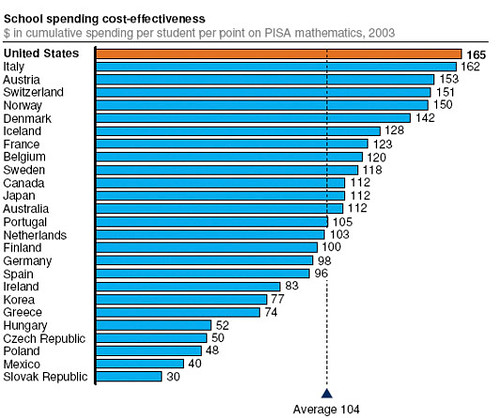
Unfortunately, throwing money at the system doesn't seem to help, either. As it is, the United States gets comparatively little bang for its buck on education spending. The United States spends more than any other country per point on the PISA math exam, and 60 percent more than the O.E.C.D. average:
<a href="http://ec.europa.eu/enterprise/e_i/news/article_8903_en.htm">Showcasing regional innovation</a>
<a href="http://ec.europa.eu/enterprise/newsroom/cf/itemshortdetail.cfm?item_id=3080">Conference ''Tourism Industry: Employment and Labour Market Challenges''</a>
<a href="http://www.istat.it/salastampa/comunicati/non_calendario/20090430_00">I nuovi indici del lavoro e delle retribuzioni nelle grandi imprese in base
2005 e Ateco 2007</a>
<a href="http://ec.europa.eu/enterprise/newsroom/cf/itemlongdetail.cfm?item_id=3083">Modernisation of EU research funding on the right track - Questions and
Answers</a>
How does FP7 work? What is its structure?
FP7 supports a broad range of research activities grouped under four Specific Programmes: "Cooperation," "Ideas," "People" and "Capacities." The total budget is EUR 54bn from 2007 to 2013 (including a Euratom budget of EUR 4bn).
<a href="http://people.uis.edu/rschr1/onlinelearning/2009/05/schools-tools-teaching-tech-savvy.html">Schools’ tools teaching tech-savvy generation - CLAIRE MILLER, Gainesville Times</a>
<a href="http://www.etf.europa.eu/Web.nsf/(RSS)/321D09D95C8B2D01C12575AE002B3A02?OpenDocument&LAN=EN">Mutual learning puts you in the driving seat</a>
<a href="http://people.uis.edu/rschr1/onlinelearning/2009/05/employer-perceptions-of-online-degrees.html">Employer Perceptions of Online Degrees: A Literature Review - Norina L. Columbaro & Catherine H. Monaghan, OJDLA</a>
<a href="http://www.etf.europa.eu/Web.nsf/(RSS)/301E3A81898EC6EEC12575A80050E266?OpenDocument&LAN=EN">New ETF project to promote mutual learning</a>
<a href="http://eacea.ec.europa.eu/llp/funding/2009/call_nlls_2009.html">Support for European cooperation in Education and Training - Call for
proposals</a>
<a href="http://eacea.ec.europa.eu/llp/funding/2009/call_eqf_2009.html">European Qualifications Framework (EQF) - Call for proposals</a>
<a href="http://www.etf.europa.eu/Web.nsf/pages/Events_EN?OpenDocument&emb=http://www.etf.europa.eu/EventsMgmt.nsf/(RSS)/D7FCF1743B46397FC125757F0046ACC7?OpenDocument&LAN=EN">Event: 27/05/2009 - LEARN project Study Visit to CPI, Slovenia - From ‘best
practice’ to ‘next practice’</a>
LEARN project Study Visit to CPI, Slovenia - From ‘best practice’ to ‘next practice’ VET Teachers as Change Agents for the Autonomy of VET Schools - - the Role of VET Centres
Study Visit of the LEARN project network to learn of the experience of the Slovenian VET sytem and the National Institute of VET. The event will also provide an opportunity for a meeting of the LEARN Steering Committee and to focus on the LEARN project activties of benchmarking project, preparation of the strategy papers and other project documents.